Real estate
PropTech
Platform

Living Area Calculation: Why an Accurate Number Can Still Be the Wrong One

The same home can have more than one "official" size, and every one of them can be accurate. This article is about what decides which one you actually need, and why getting that right matters as much as measuring carefully in the first place.

Reading time

7

min

Published on

August 25, 2026

Written by

Camille Zimmermann

Marketing Manager

Share this article

LinkedIn iconX iconIcon facebook

Ask a letting agent, a bank, and an architect how big the same apartment is, and you can get three different answers, and all three can be correct. Not because anyone guessed or measured badly, but because "how big is this home" isn't one question. It's several, and each one is answered with a different ruler.

A living area calculation is the service that turns an existing floor plan or sketch into an official square-meter figure. It doesn't require anyone to visit the property, the plan already exists, the job is calculating the number correctly from it. The part that surprises people: "correctly" depends entirely on which ruler the situation calls for. A 68 square meter apartment can be accurately calculated as 61 square meters for a lease, and 74 for a mortgage file, with the same walls in the same place. Floor area accuracy is a legal shield, we've made that case before, and this is the step that comes before it: accuracy only means something once you know which standard you're being accurate against.

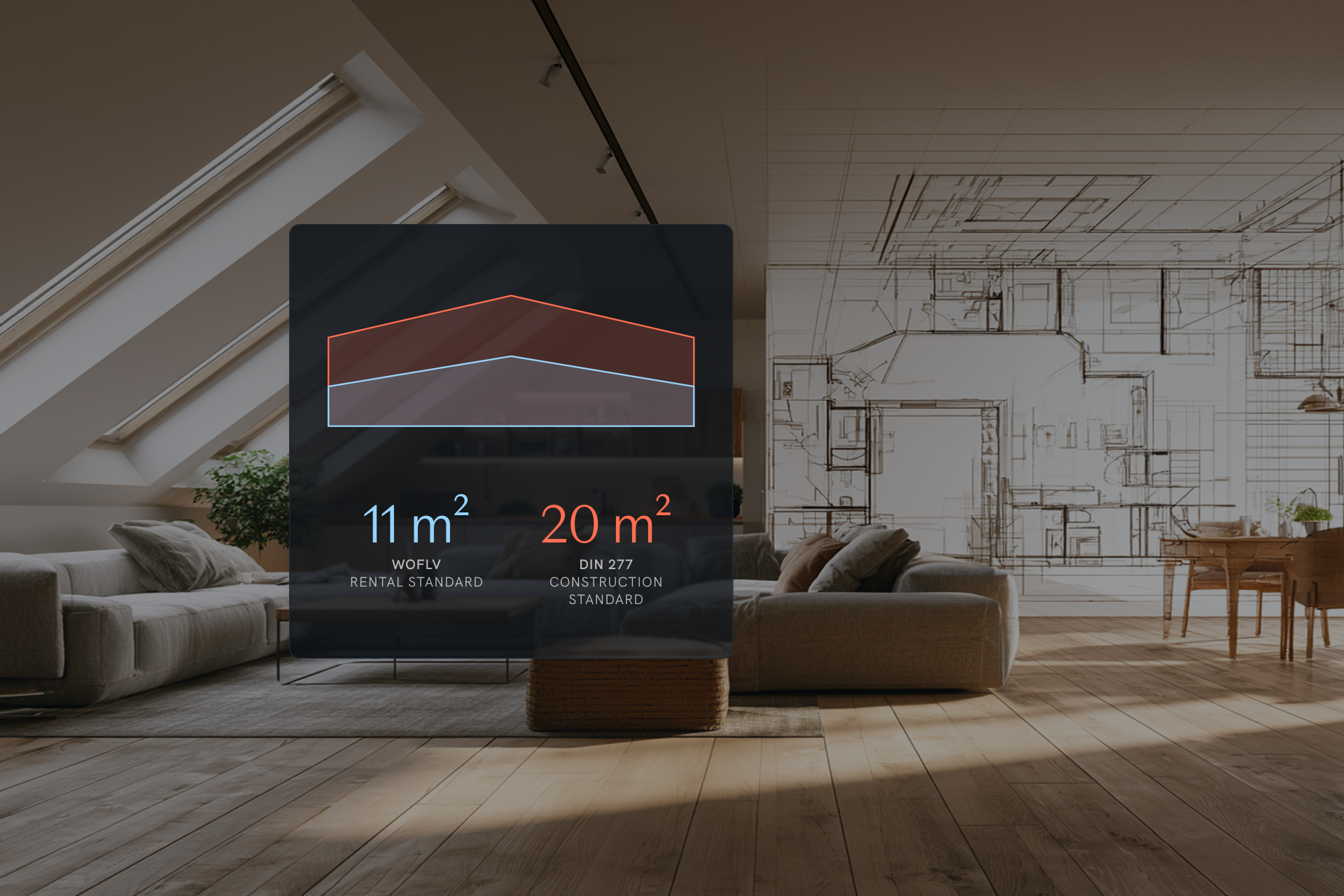
Side-by-side comparison: the same 20 m² attic room measures 11 m² under the WoFlV rental standard and 20 m² under DIN 277.

Germany's version: two rulers, one apartment

Germany has the clearest, most codified example of this. One standard, called WoFlV (short for Wohnflächenverordnung, the German living space ordinance), is built for rental housing. Another, DIN 277, is a construction standard built to describe buildings, and many sale listings and standard-form leases use it instead. They don't just have different names, they measure differently:

Factor
WoFlV — rental standard
DIN 277 — construction standard
Balcony / terrace
Up to 50% of its area
100%
Sloped ceiling (attic)
0% under 1m · 50% 1–2m · 100% above 2m
100%, regardless of height
Basement / technical rooms
Excluded
Included
Typically used for
Rental leases, courts, banks
Construction, architecture, listings

Take a 20 square meter attic room and run it through both columns. WoFlV returns 11 square meters. DIN 277 returns 20. Both numbers can be measured perfectly, carefully, accurately. The room hasn't changed size. The ruler has.

The same pattern, in three more countries

Germany didn't invent this, it just wrote it down more clearly. The same "which ruler" question shows up across Backbone's other markets too, under completely different names:

Switzerland
Net living area (NWF)
82 m²
Gross living area (BWF)
96 m²

Each figure adds back something the previous one left out — walls, then low-ceiling space, then hallways and stairs. Sales use the net figure, most rentals the gross one.

Belgium
Listing's stated living area
110 m²
EPB certificate area
94 m²

The EPB figure only counts space inside the home’s insulated, heated boundary. A fold-down-ladder attic can be "usable space" on a listing and not exist on the EPB.

Spain
Superficie útil (usable)
88 m²
Superficie construida (built)
105 m²

Útil is measured inside the walls. Construida adds the walls plus a share of shared building structure, typically 15–25% more. Mortgages and property tax use construida.

Four countries, one shape: the building never changes size. The number changes depending on who's asking and why they need it.

Why picking the wrong one is a real problem, not a technicality

In Germany specifically, a lease decides which ruler applies. If the contract doesn't say, WoFlV is what a court will use by default (BGH, 22.04.2009, VIII ZR 86/08). But if the lease specifies DIN 277 instead, courts have upheld that too, especially outside rent-controlled housing. Neither standard is more "official." They just answer to different things: WoFlV to the lease, DIN 277 to the building.

That distinction doesn't expire, either. In October 2023, Germany's top civil court heard a landlord argue that an area figure from years earlier, calculated under an older method, should still count for a lease signed in 2014. The court disagreed: whichever standard was legally required on the day the lease was signed is the one that applies, no matter when the property was actually measured (BGH, 17.10.2023, VIII ZR 61/23). An old number doesn't carry forward on its own. Only an old agreement does.

Most of the time, this doesn't play out as a courtroom argument. It plays out as a rejected document. A bank asks for WoFlV, since that's frequently what they require, and receives a DIN 277 figure instead, and the file doesn't come back flagged as wrong, it comes back rejected as the wrong calculation entirely, and the whole application waits behind everyone who submitted the right one the first time. Court filings, notarial paperwork, and lease renewals fail the same way, in every market above, and not because anyone measured carelessly.

The one-sentence version for an agent to actually use: before ordering a calculation, ask "what is this number for," not just "how big is it." That question costs nothing. Getting it wrong costs a resubmission.

Not the same thing as on-site measurement

Worth being clear on this, since the names sound similar: a living area calculation works from a floor plan or sketch that already exists, nobody needs to visit the property. On-site measurement is a different service entirely, for when no reliable plan exists yet and someone has to go measure the property before any number can exist at all, covered in our guide to on-site area measurement. Which of the two you need is the first question. Which standard sounds more official comes after.

Does a floor plan or sketch already exist?
YES
NO
Desk-based
Living area calculation
No site visit needed
On-site
On-site measurement
Someone visits to measure first

What Backbone actually delivers

Send in the existing floor plan or sketch, with height lines wherever a ceiling slopes. For the German market, Backbone's documentation team calculates against whichever of WoFlV or DIN 277 the intended use, a lease, a sale, a financing application, a tax filing, actually requires, not whichever produces the bigger number. Delivery takes two business days, with an architect's stamp available for anything that needs to go to a bank, a court, or another official body.

An accurate number and an accepted number aren't always the same thing. The second one was measured against the ruler the reader was actually holding.

Living area calculation
Germany: WoFlV / DIN 277
1
Send the floor plan or sketch
2
We identify the required standard
3
Calculated against that standard
4
Delivered, stamp optional
Delivery
2 business days
Standard
WoFlV / DIN 277
Input needed
Existing floor plan or sketch
Add-on
Architect's stamp

Get a living area calculation measured against the standard your listing, lease, or loan file actually needs. Request your calculation →

Thank you! Your submission has been received!
Oops! Something went wrong while submitting the form.
HomeBlog
-
Living Area Calculation: Why an Accurate Number Can Still Be the Wrong One

Frequently asked questions

Doesn't this contradict the idea that floor area accuracy is a legal shield?
Arrow icon

No, it comes before it. Accuracy means a number correctly matches reality once a standard has been chosen. This article is about choosing the right standard in the first place. A number that's accurate against the wrong standard fails for a different reason than an inaccurate one, but it still fails.

What is a living area calculation, exactly?
Arrow icon

A desk-based service that calculates a property's official living area from an existing floor plan or sketch, without needing to visit the property. The result depends on which standard applies to the intended use, a lease, a sale, financing, or a tax filing.

Is this only a German issue?
Arrow icon

No. Germany's WoFlV/DIN 277 split is the clearest example, but Switzerland (net vs. gross living area), Belgium (EPB certificate area vs. listing area), and Spain (useable vs. built area) all show the same pattern: one home, more than one correct number, depending on the question being asked.

What's the actual difference between WoFlV and DIN 277?
Arrow icon

WoFlV is the default German standard for rental living area when a lease doesn't specify otherwise. It reduces balconies and sloped ceilings and excludes basements. DIN 277 counts most of those spaces at full area, which is why it runs larger, and many leases specify it directly, which courts have upheld outside rent-controlled housing.

Can I keep using an old living area calculation for a new lease?
Arrow icon

Not automatically. Courts have confirmed the standard that was legally required when the lease was signed applies, regardless of when the property was originally measured. An outdated figure can be rejected outright rather than quietly accepted.

Do I need someone to visit the property to get a living area calculation?
Arrow icon

No, not if a usable floor plan or sketch already exists. If no reliable plan exists yet, on-site measurement comes first.

How long does a living area calculation take, and can I get it stamped?
Arrow icon

Two business days from a complete floor plan or sketch, for the German WoFlV/DIN 277 service. An architect's stamp is available for anything that needs to be submitted officially.